
Small Wetlands, Big Impact
Supporting Delta Waterfowl during American Wetlands Month means healthier duck breeding habitat and stronger fall flights
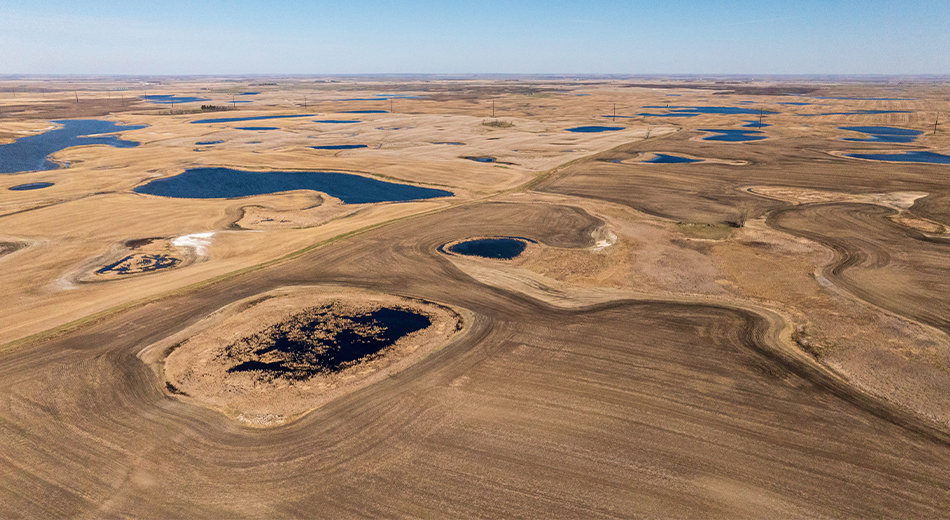
When a flock of ducks hovers over your decoys, there’s a good chance they flew down from the same region of North America. Known as the prairie pothole region, this immense grassland — spanning the Dakotas, Iowa, Montana, Minnesota, Manitoba, Alberta, and Saskatchewan — is peppered with wetlands that hatch up to 70% of the continent’s ducks.
The PPR gets its name from its glaciated landscape resulting in a vast expanse of depressions that hold water for varying periods — some for a few weeks or months, while others are wet for years. It’s tempting to assume that duck production is highest in picturesque, large marshes. But when it comes to producing ducks in the prairies, the most unassuming, smallest ponds have the greatest impact. In fact, 10 one-acre wetlands can support three times the number of ducks as one 10-acre wetland.
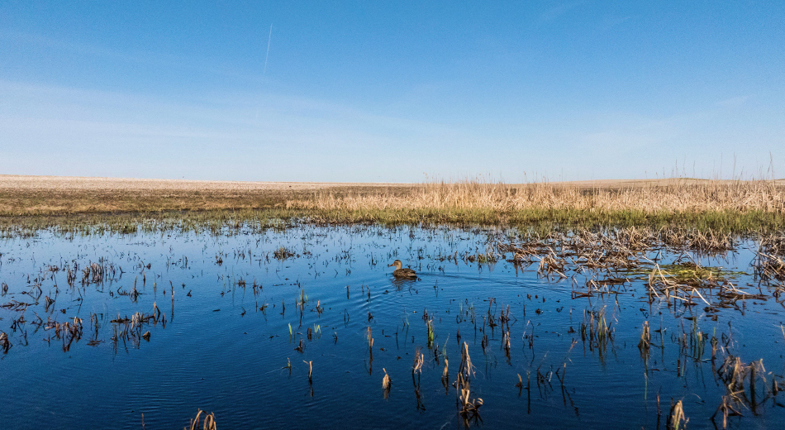
Without this crucial habitat, waterfowl populations would collapse. We’re already starting to see the effects of widespread wetland loss in the prairies.
Most of the small wetlands in the PPR can be found on private lands — in crop fields, pastures, and hay lands. These potholes are often perceived to impede farming operations by lowering crop yields and making it more difficult for planting and harvesting machinery. As a result, they’re the most at risk for drainage. From 1997-2009, more than 93,500 acres of wetlands disappeared across the PPR in the United States. Since then, losses have accelerated, exacerbated in recent years due to prolonged drought. With fewer small wetlands available to nesting hens, last year’s breeding duck population hovered around 34 million, which is 4% below the long-term average from 1955 to 2025.
Delta Waterfowl continues to work harder than ever to slow the tide of wetland losses and ensure ducks have breeding habitat through voluntary, incentive-based habitat conservation programs. Delta’s programs collaborate with and reward farmers who retain small wetlands on their working lands. In the U.S., Delta pioneered the Working Wetlands program, which was included in the 2018 Farm Bill, while in Manitoba these efforts are manifested in the Shallow Wetland Incentive Program. Delta continues to work with U.S. policymakers to implement the Migratory Bird Resurgence Initiative, which would conserve 336,000 acres of small, shallow wetlands in the PPR.
By supporting Delta Waterfowl during American Wetlands Month, you’re helping to keep small wetlands on the landscape, leading to healthier breeding duck habitat and more ducks in the fall flight.