
Small-Bore Survival
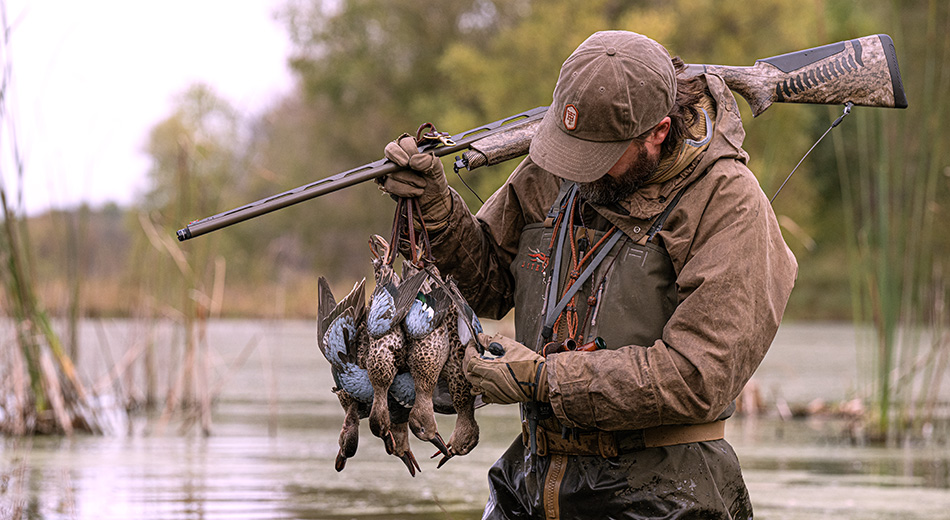
Will the 28-gauge remain a viable duck gun now that premium waterfowl loads have become so expensive and scarce?
BY PHIL BOURJAILY
The 3-inch 28-gauge was a hit as soon as it appeared, not just among upland hunters who saw it as a pheasant gun, but turkey hunters and waterfowlers, too. Everyone loved it, with the exception of 12-gauge-shooting me, but no one asked my opinion. I didn’t share my thoughts, either, because who wants to be a killjoy?
Besides, I understand why people choose little guns. A 28-gauge like the Benelli SBE3 weighs 5½ pounds. It’s cute. After shooting a limit of wood ducks with the dainty gun one morning, I sat on the bank of the narrow, wooded pond until the geese that liked to loaf there returned. They came down through the trees, honking unseen above the canopy for yellow leaves clinging to the trees, finally coming into sight low over the pond. I waited for them to backpedal, then doubled on giant Canadas with a tiny wisp of a shotgun. So yes, I get the appeal. Even so, I sent that gun back after I reviewed it and picked up my 12s again because I am no fun that way.
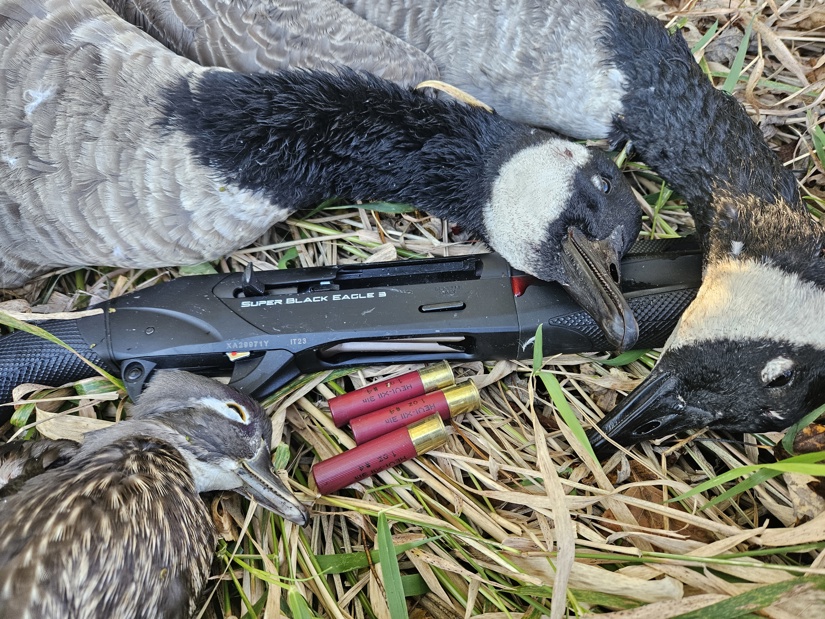
Due to its density, tungsten and bismuth shot popularized the 28-gauge among duck hunters. Now that those metals are in short supply, steel (and possibly copper) shot will be the standard for sub-gauge enthusiasts this fall.
But, this isn’t about me. It’s about you. You jumped on the smallbore train, but now the price of tungsten-iron shot keeps increasing, and the supplies of bismuth are drying up, and you’re going to have to shoot steel. My advice to 28-gauge shooters is, stock up on whatever bismuth you can find, and steel yourselves for the future, which, I found out, is not all bad.
28-Gauge History
The 28’s status as a waterfowl gun is new. Twenty-eights were made in England through the latter half of the 19th century, and popularized in the U.S. when Parker began making its double guns in 28-gauge in 1903. The first 28 shells had 2½-inch hulls loaded with black powder. In the late teens or early 20s, a 27/8-inch 28 containing the now-standard ¾ ounces of shot appeared, and the familiar 2¾-inch, ¾-ounce 28 load appeared in the early 1930s.
When the 28 was selected as one of the four gauges for competitive skeet, shooters learned that at inside 30 yards, a ¾-ounce payload was heavy enough to break targets, and light enough to be very pleasant to shoot. The 28 built a cult following among grouse and quail hunters, with dove hunters, anyone who appreciated an effective, light-kicking cartridge and the trim guns that fired it.
Along the way, a lot of ink flowed over the ballistic wonders of the 28-gauge. Allegedly, the .550-inch bore of the 28-gauge and the height of a ¾-ounce lead payload were equal, creating the mythical “square load,” albeit through a round hole. Such a load, 28-gauge boosters told us, patterned and killed better than it had a right to. Even if it were actually a square load (in fact, the shot column is taller than the bore diameter), squareness doesn’t confer magical ballistic powers. Pattern efficiency tends to correlate with bore diameter, and bigger is better.
To be fair to the 28, much greater shotgun minds than mine—Michael McIntosh, Bob Brister, and Gene Hill—believed in its magic. Hill even called it “the thinking man’s 20-gauge.” It’s worth noting, though, that all three knew only the 2¾-inch 28 and lead ammunition.
Arguing about the 28’s patterning ability and short shotstrings is more or less moot because hard steel and TSS pellets don’t string out much in any gauge. Also, in lengthening the 28-gauge hull to 3 inches, we have made it even less square than it already was.
Benelli started making its Ethos 28 with 3-inch chambers in 2016, but it wasn’t until recently that we’ve had 3-inch 28-gauge ammunition.
The 28 & Steel
Stretching the 28-gauge hull allowed it to hold an ounce of HEVI (formerly Hevi-Shot) or bismuth, turning it into a potent waterfowl load. That was then, and even though “then” wasn’t that long ago, now, if you’re going to shoot 28s at waterfowl, you’re shooting steel (and copper, assuming it is approved by next season). Thus far, the ammo industry hasn’t made many 28-gauge steel loads in waterfowl sizes. The only duck-specific 3-inch 28-gauge steel ammo I could find was Federal’s Black Cloud, which contains ¾-ounce payloads of 3- or 4-shot with a muzzle velocity of 1,400 fps.
Just as with the larger gauges, Federal’s recently released 3-inch 28-gauge Black Cloud contains a 60/40 blend of round and ridged pellets loaded into the Flitecontrol Flex rear-braking, tight-patterning wad. I hope we can all agree that 1,400 fps 3-shot makes a good all-around duck pellet, and 4s at that same speed are fine for decoying ranges.
The first thing I did was cut open some shells, weigh the payloads, and count the pellets. The 3-shot shells contained an average of 114 pellets, and weighed 313 grains (.73 ounces). The 4-shot loads averaged a lighter 302 grains (.70 ounces) and contained 127 pellets. Other lots of Black Cloud 4s may weigh the full ¾-ounce. Factory-loaded shells can vary. In any case, neither 3s nor 4s give you a lot of pellets to work with when you only have room in a hull for ¾ of an ounce of shot.
If you go by shotshell expert Tom Roster’s CONSEP lethality tables, it takes a minimum of 85 to 90 pellet strikes in a 30-inch circle to consistently kill mallard- and gadwall-sized ducks, and 115 to 120 in 30 inches for medium-sized ducks like wigeon and woodies. Mallard-level lethality seemed like a tall order, but I armed myself with a 28-gauge Retay ACE-R and a factory modified choke and shot some patterns at 25 and 35 yards. I liked what I saw.
Stay In Range
At 25 yards, the 3s averaged around 100 hits, and the 4s about 120. With both loads, all the pellets were concentrated in about 22 inches of my 30-inch circle. So, while you might not have much margin for error at the range, if you hit any size duck with the center of that pattern, you have more than enough density to kill it cleanly.
At 35 yards, I got about the same number of hits in the 30-inch circle with both loads as I had at 25 yards. The difference was that at the longer distance, they filled out the entire circle nicely, giving you a pattern that’s easier to hit with. I would call 35 yards the maximum range for either load.
Another steel option for the 28 is the 5/8-ounce load of 6 shot. Federal’s Upland Steel comes in 6- and 7-shot at 1,350 fps. Seven shot is, I think, too small for any ducks, although I have shot a bunch of doves with these in a 28. Six shot has just enough energy inside 30 yards, especially if you’re getting multiple hits on the bird. The Federal loads averaged 62%, working out to 124 hits in a 30-inch circle. Although the patterns had enough pellet strikes in them to satisfy Roster’s requirements for large and medium ducks, they were also beginning to open up in such a way that I wouldn’t shoot them past that distance.
You can shoot your own patterns and draw your own conclusions, but I would be confident with a 28 and Black Cloud on a wood duck hunt, or for mallards in timber or tight spots.
In this post-premium shotshell era, a 28-gauge won’t be your all-around duck gun anymore (I always thought they were too light for good longer-range shooting anyway), and I wouldn’t take one goose hunting, but it’s absolutely a gun you can break out for those days when you want to shoot ducks up close.
Captions:
Due to its density, tungsten and bismuth shot popularized the 28-gauge among duck hunters. Now that those metals are in short supply, steel (and possibly copper) shot will be the standard for sub-gauge enthusiasts this fall.
Since debuting the Ethos in a 3-inch 28, Benelli has added the SBE to the mix. Remington was the first to offer a semi-auto 28 with the 11-48 and 1100.
Photo credits: Photo courtesy of Benelli, Phil Bourjaily