
Louisiana Hunters Afforded New Special Season for Black-Bellied Whistling Ducks
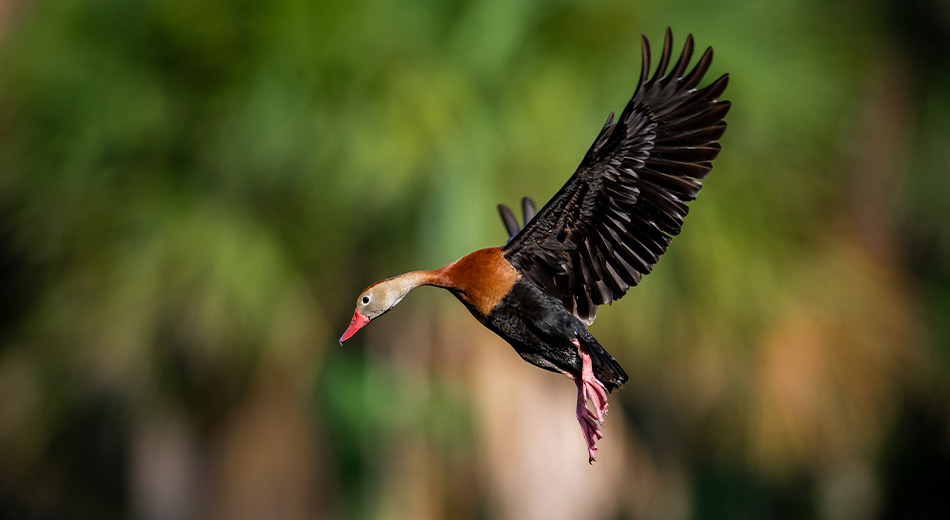
Rising populations and behavioral habits pushed wildlife managers to expand hunting opportunities for the tree-dwelling birds
BY JONATHAN OLIVIER
Nate Verdin gazed near the top of a cypress tree at two ducks sporting black, white, and chestnut plumage. When they flew off, the pair’s elongated pink feet trailed behind their tail feathers as they released a chorus of whistles. 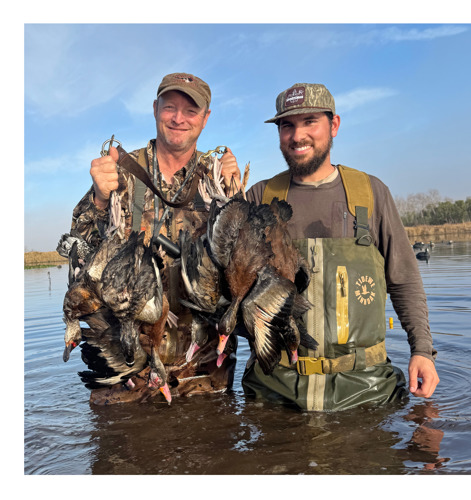 Verdin had never seen the birds in Louisiana, but his dad had heard about these newcomers and pointed out that they were black-bellied whistling ducks, a common species found in south Texas and Central and South America. After that first sighting near Paradis in 2005, Verdin began noticing them pop up practically everywhere: parks in New Orleans, roadside ditches, subdivisions, golf courses, and coastal wetlands.
“I looked at them as the pigeon of waterfowl,” Verdin said, who founded Falling Tide TV, a YouTube hunting show. “I thought: ‘That thing can’t taste good.’”
Over the years, Verdin began hearing from other Louisiana hunters who bagged the occasional whistling duck that the birds were solid table fare. It wasn’t until a slow morning in 2020 that Verdin’s curiosity got the best of him while afield with his brother in Big Branch Marsh National Wildlife Refuge. “A flock of whistling ducks came over us that day, and I said, ‘Let’s just shoot them,’” he said.
They knocked down a few and, later that afternoon, Verdin figured he’d prepare his unfamiliar quarry like he does all ducks—pan-seared to medium rare. One bite and he was hooked.
“They are the best tasting duck out there,” Verdin said. “They don’t have the deep red color like mallards or gadwall. It’s a light-colored meat, and the flavor reflects that.”
Verdin takes every opportunity he can to harvest black-bellied whistling ducks. This October, there will be more chances to hunt the tree-dwelling birds. After years of discussions about creating a standalone season for black-bellied whistling ducks in the state, the Louisiana Department of Wildlife and Fisheries worked with the Mississippi Flyway Council and the U.S. Fish and Wildlife Service to create the framework for an experimental season to run Oct. 3-11 with a four-bird daily bag limit.
“We don’t get the mallards we used to—a lot of things have changed over the years. So, we’re missing some opportunities we used to have,” Verdin said. “It’s really good when we’re able to gain new opportunities like that.”
An Expanded Range
Black-bellied whistling ducks go by many names: Mexican whistlers, tree ducks, and squealers. Compared to the ducks most hunters are familiar with, whistling ducks are unusual. The birds lack sexual dimorphism, which means drakes and hens look identical. Much like geese or swans, pairs are monogamous, form long-lasting bonds, and travel in family groups.
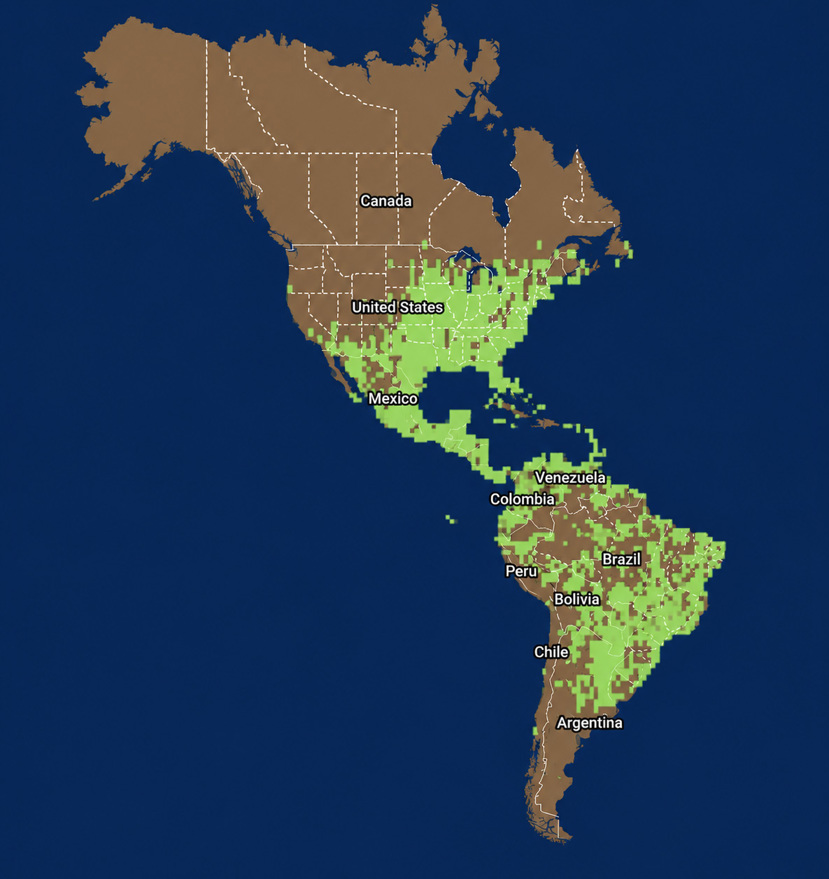
This map details the range of black-bellied whistling ducks. They originally called Central and South America home, but expanded north into the U.S. and Canada.
Their home range originally encompassed portions of South and Central America. In the mid-20th century, there was evidence that whistling ducks began flying north of the Rio Grande to establish breeding populations in south Texas. Then, starting in the 2000s, the birds became more common along the Gulf Coast, eventually becoming year-round residents in Louisiana and Florida.
Lately, whistling ducks have expanded northward, regularly nesting just up the Mississippi River in Tennessee and sporadically breeding as far north as Minnesota. In the summer, sightings of whistling ducks have been reported along the East Coast and as far north as Canada. Jason Olszak, LDWF waterfowl program manager, noted these tropical ducks are unlikely to establish year-round residency much farther north than Louisiana.
“We’re now at the northern edge of their permanent range,” he said. “After cold winters, we see birds with missing toes and missing feet. Injuries happen to ducks, but for the volume we’re seeing, I think they’re probably suffering from frozen appendages. And this is apparently the limiting factor in the expansion of their core, year-round range farther north.”
Olszak said for years there was a lot of uncertainty about black-bellied whistling ducks. Since they showed up so quickly, questions remained about their migration habits, where they spent much of the year, or how many were in the state. He said there’s finally enough data to put some of those questions to rest.
“We have about 15 years of banding data on black bellies,” Olszak said. “We did an analysis of band returns, and 75% of those ducks banded in Louisiana were reported in Louisiana.”
Other data points, like more whistling ducks tallied during aerial waterfowl counts in January and increased sightings recorded on the Cornell Lab of Ornithology’s eBird app, confirmed a long-standing suspicion among wildlife officials that most of the birds in Louisiana are permanent residents.
It’s still hard to say exactly how many call the state home. Approximations from the LDWF’s annual mid-winter waterfowl inventory, with the most recent five-year average from 2020-2024, put whistling duck numbers at more than 140,000, which is likely a low estimate.
Population trends supported a standalone season, but wildlife officials found that whistling ducks were more vulnerable to harvest in early fall, which led them to choose October.
Katie Miranda, a graduate student at Louisiana State University, has been studying black-bellied whistling duck movements in Louisiana using light-level geolocators, which use ambient light levels to estimate a bird’s location. She noticed that many whistling ducks are documented in areas with high light pollution from November through the winter, indicating they’re waiting out hunting season in urban areas.
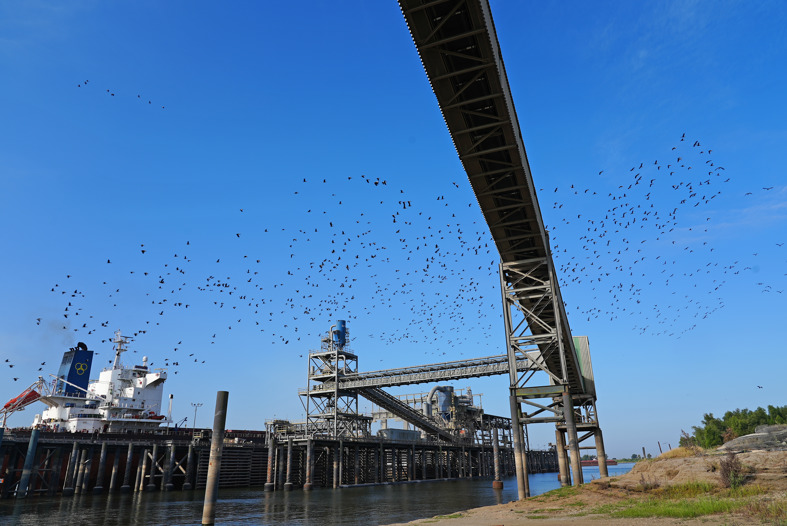
Whistling ducks are concentrating around grain elevators, causing a food hazard. There have been reports of ducks being buried in grain and found dead on ships.
“We can’t tell exactly whether or not it’s associated with hunting,” she said. “But it seemed like the patterns of [recording] light pollution did really seem to line up with our season dates and what hunters report. A lot of hunters in the state are saying that the whistling ducks aren’t there for them to harvest.”
Verdin, who logs as many days in the blind as he can, said he’ll only see whistling ducks when the weather is warm for an extended period. Otherwise, he said, they seem to disappear with many congregating near grain elevators hugging the banks of the Mississippi River. “You’ll have thousands of them over there,” he said.
Miranda pointed out that whistling ducks amass at grain elevators year-round with numbers increasing in the fall and winter. There are so many of them that it’s becoming a food safety issue, with reports of birds getting buried by grain and dying on ships.
“They sit there and they eat all day, they eat all night,” she said. “You can drive a truck or do whatever to try to bump them off the grain, and they seem to come right back.”
High Nest Success
Mild winters in the South (and their ability to thrive in urban areas) have opened up more habitat for whistling ducks. Wildlife officials also believe these ducks exhibit certain characteristics that could be contributing to their rapid expansion.
As tree cavity nesters, whistling ducks have adapted to laying eggs in wood duck nest boxes. Dylan Bakner, who studied cavity nesting waterfowl as a doctoral student at LSU, said it’s common to find multiple whistling ducks laying eggs in the same box, resulting in many clutches containing over 20 eggs. He’s seen nests with upwards of 40 eggs and has read about one account in Texas that included 101.
“Another thing that’s interesting about them, and likely why they’re able to incubate such large clutches, is that both sexes incubate,” Bakner said. “So, there’s never really a need for that nest to be vacated for a couple of hours each day while the hen recesses because the male can just take right over.”
Bakner said that having hens and drakes share incubation duties can reduce egg loss to predators, and this further contributes to higher productivity among whistlers.
“They appear to be pretty good at being a productive animal,” he said.
Hunting Whistling Ducks
Clark Cormier is one of the rare Louisiana hunters who regularly encounters whistling ducks throughout duck season. In the last few years at Cherry Ridge Hunting Club near Lake Arthur, where he’s worked as a guide since 1973, whistling ducks have started to make up most of the daily bag limits. Last season, Cormier said the hunting club tallied around 4,000 whistling ducks.
“We have thousands of them in our marsh, but the surrounding marshes don’t have any,” he said. “They just find the place that they like, and they roost there.”
Cormier has learned that hunting whistling ducks isn’t like targeting most waterfowl. When he sees a group of them, he never expects a shot over the decoys. “They will not light into the spread,” he said. “If you have water all around your blind, they’re just passing.”
Cormier said whistling ducks offer solid pass shooting opportunities. They’ll take a flight line, get shot at, and the same group is likely to circle back towards the blind. He often entices the birds closer with a pintail whistle to mimic their vocalizations.
“They’ll come see what the racket is, and they’re just 15 feet over your blind, 30 of them,” he said.
By the end of winter, the whistling ducks vacate Cormier’s 4,000-acre hunting club and many of the urban areas they inhabit to gather in large pre-breeding flocks before pairing up and breeding in the summer.
During the September teal season, Olszak said hunters often report seeing whistling ducks in large numbers. So, as hunters go afield in October, he expects harvest opportunities to be high as the birds won’t yet be congregated in urban areas.
“This is an expanding population and we’re expanding recreational opportunities at a time we think harvest vulnerability might be a bit higher than during the regular season,” he said.
Captions
This map details the range of black-bellied whistling ducks. They originally called Central and South America home, but expanded north into the U.S. and Canada.
Whistling ducks are concentrating around grain elevators, causing a food hazard. There have been reports of ducks being buried in grain and found dead on ships.
It's common for multiple whistling ducks to lay eggs in the same nest. Waterfowl managers regularly see clutches of 20 eggs or more.
Later in the year, whistling ducks congregate in urban areas, but in early fall they are often in the marsh, so there should be ample opportunities for hunters.
Photo credits: RC Gilliland, Nate Verdin, Google Maps/E-bird, Louisiana Department of Wildlife and Fisheries, Louisiana Department of Wildlife and Fisheries