
Conservation on Working Lands
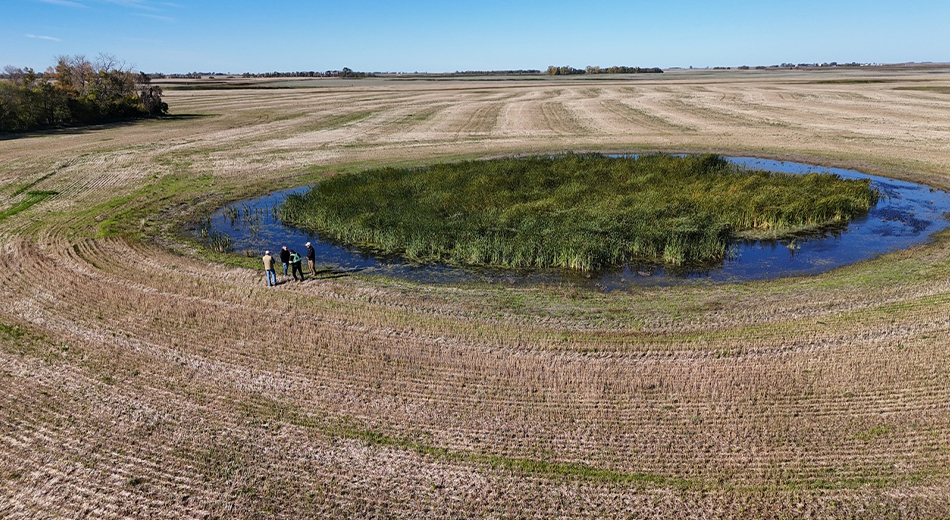
A Delta-inspired program rewards Canadian farmers for keeping more wetlands available to breeding ducks
By Joe Genzel
Duck hunters know that more wetlands on the breeding grounds equal more ducks. In the prairie pothole region of Manitoba, Delta Waterfowl is working to maintain waterfowl populations by advocating for partnerships with landowners and farmers to keep critical small wetlands on their fields through the Shallow Wetlands Incentive Program.
SWIP is a Delta-modeled program that pays farmers not to drain small wetlands embedded in their crop fields.
“Breeding ducks need shallow wetlands to reproduce,” said Jim Fisher, Delta’s vice president of Canadian policy. “We know that 10 one-acre wetlands attract 20 breeding pairs of ducks, while one 10-acre wetland attracts just seven pairs. Shallow wetlands in croplands are the most vulnerable. SWIP creates an incentive for all farmers to consider before they decide what to do with their land.”
Manitoba adopted SWIP in 2018 as part of Growing Outcomes for Watersheds, a provincial initiative that funded an endowment for conservation. One of Manitoba’s goals is to conserve 90% of the province’s small, shallow wetlands.
In the Canadian PPR (Manitoba, Saskatchewan, and Alberta), wetland loss has been estimated at 0.37% annually. On croplands, the rate increases to 0.88%. To incentivize landowners to keep more water on their fields — and attract more nesting ducks — the Manitoba government committed $204 million to trust funds held by the Winnipeg Foundation, which distributes 4% to 5% per year to fund SWIP and other programs administered by GROW.
Since 2020, $7.5 million per year has flowed to Manitoba’s watershed districts, $2.5 million of which has been allocated to SWIP each year. Watershed districts apply for annual grants and then sign farmers to10-year agreements that protect Class 1 and 2 (ephemeral and temporary) wetlands on private lands, where an estimated 90% of duck production occurs.
In Manitoba, Class 1 and 2 wetlands can be drained by farmers who register their intent with the government; no mitigation (replacing the drained wetland habitat somewhere else) is required, which results in less breeding habitat for ducks.
SWIP's core requirement is that enrolled farmers agree not to drain the wetlands. They can still farm through them when conditions allow but cannot install ditches or tile drainage to remove water permanently.
Based on the $14 million allocated since the program started six years ago, an estimated 17,400 acres of shallow wetlands (94,000 basins) will be enrolled in SWIP through 500 landowner agreements.
SWIP By the Numbers
“SWIP expanded the district's reach to grain farmers on cultivated acres (cropland), a demographic that previous programming had not served well,” said Dean Brooker, general manager at Souris River Watershed District.
Producer Partnerships
Farmers plant and harvest as much of their land as possible to make a living. In the PPR this can lead to draining the small, temporary wetlands that breeding ducks rely on each spring.
It’s why farmers and waterfowl hunters sometimes find themselves on opposite sides of the table.
In the United States and Canada, conservation easements have been the main way wetlands on private property become protected. Landowners enroll a set number of acres in an easement, receive a one-time payment, and keep ownership of the land. Most conservation easements are perpetual, which means the wetlands can never be drained, no matter who owns the property — good news for duck production.
Understandably, some landowners are cautious about locking up portions of their property in this manner. SWIP offers Canadian farmers another option that provides more flexibility.
“We work the low land when it’s dry, but when it’s wet, we won’t,” said Murray Combs, whose family has been farming near Deloraine, Manitoba, for five generations.
Combs, 69, has passed the farm’s daily operation to his son Nic. The family farms 1,280 acres, primarily growing wheat and canola. Combs’ farming philosophy has been shaped by decades of experience, including lessons from his father, who lived through the Dust Bowl era of the 1930s when waterfowl populations crashed due to prolonged drought.
He has long advocated against draining the low-lying areas in his fields, preferring to farm them when conditions permit and leave them alone when they're underwater, so breeding ducks have a place to raise their broods.
SWIP appeals to Combs because it provides compensation for maintaining shallow wetlands without permanently restricting how his family can use the land.
It’s an example of how conservation incentives can support both wetland habitat and working farms.
“Murray’s story illustrates why farmers choose to enroll in SWIP despite the economic signals to drain wetlands,” Fisher said. “Draining would allow corner-to-corner farming and eliminate crop losses in flooded basins, but Murray has made the choice to pick conservation, so that there is more waterfowl habitat for ducks in southwest Manitoba.”
Generational Conservation
During the Dust Bowl, Combs’ father saw the consequences of drought, wind erosion, and the resulting poor soil conditions. Those experiences shaped how Combs and his son manage the land today.
“On May 14, 2026, we had a windstorm with winds reaching about 120 kilometers per hour (75 mph) that blew soil off some recently rolled fields (of neighboring farmers), and mounds of black dirt piled up in the drainage ditches,” Combs said. “That really reinforced the lessons my father passed down. It is kind of nice to recognize the people who are content to leave the land the way it is and just basically work with it."
In June, Combs witnessed something he had never seen before: His farm received 5.1 inches (13 cm) of rain in two hours. The wetland basins filled, but the soil became too wet to finish spraying his canola fields, which affected the overall quality of his crop.
Rain events like this are why many farmers drain tile their fields. Tiling removes water, shortens the time heavy equipment like tractors or combines must stay off soggy fields, and keeps crops in good health. It helps farmers maximize profit, but waterfowl in the PPR suffer because they have fewer places to settle and nest.
Combs sees it a little differently than the producers who choose to drain their fields. He doesn’t need to control every acre of the farm. He already believed in keeping wetlands intact before enrolling in SWIP. Now, an incentive supports his decision to conserve the land.
"He's been a very good representative of the program; a model participant,” said Jesse Spangler, a coordinator for SRWD. “We were one of the first districts to administer SWIP, so we have enrolled many wetlands and get quite a bit of funding to do so. The program benefits farmers, as well as waterfowl and other wildlife. It’s a win-win.”