
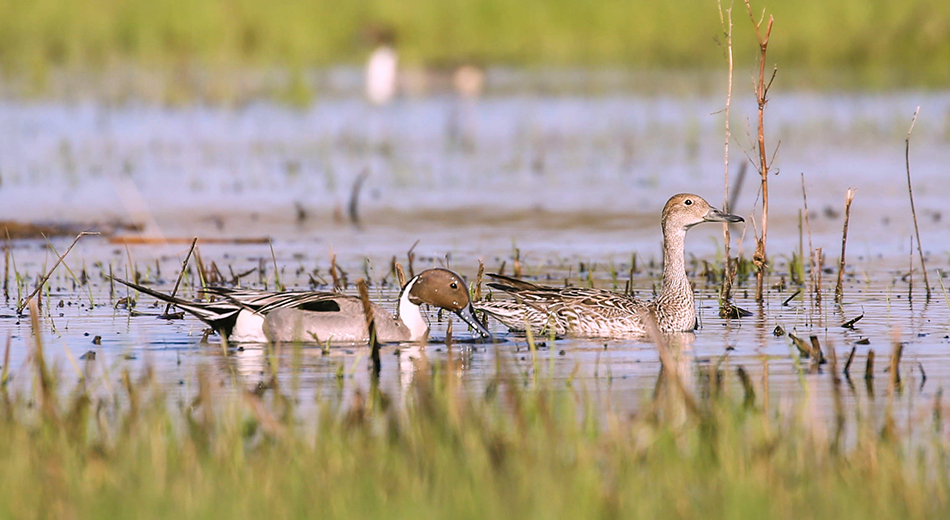
The Prairie Pintail Exodus
Populations are shifting their range from traditional breeding grounds to Alaska and northern Canada
By Dr. Todd Arnold
Northern pintails have a wide geographic range, but the Prairie Pothole Region, especially the short-grass prairies of southern Saskatchewan and Alberta, has always been regarded as the epicenter of their breeding range.
During their heyday in the mid-1970s, there were three to four times more pintails counted in the Prairie Pothole Region than in the rest of North America. But times have changed. Today’s breeding pintail population has shifted north from the prairies to the boreal and subarctic of Canada and Alaska.
For decades, the prevailing hypothesis was that breeding pintails preferred to settle in the open prairies of western Canada, venturing farther north into boreal and subarctic regions only when the prairies were dry. From 1960 to 1980, the population of prairie pintails tracked with the population of prairie ponds almost perfectly, averaging approximately 1 million pintails per 1.5 million ponds.
Prairie pintail populations still fluctuate when the prairies are wet or dry, but in recent decades, it has taken about 3.5 million prairie ponds to support 1 million pintails. From 1974 to 1981, flooded ponds declined precipitously, and prairie pintails followed suit. But even though prairie pond numbers rebounded strongly in the late 1990s and over the last two decades, prairie pintail populations have not.
Other species of prairie dabblers, such as mallards, gadwalls, shovelers, and blue-winged teal saw their populations soar from 2011 to 2016. So why did prairie pintails miss the party?
Throughout the entire history of the survey period, the population of truly “northern” pintails, those that settle in surveyed river valleys, boreal forests and tundra regions of Canada and Alaska, has remained remarkably stable, with aerial counts averaging 1.2 million birds per year. In the early 1990s, and again from 2020 to 2025, population estimates for the northern region exceeded those for the prairies.
But there’s an important caveat to these patterns – we know that we undercount duck populations in the far north. The region is vast, remote, and surveyable only by aircraft, making it difficult to reliably count ducks, and the U.S. Fish and Wildlife Service’s Northern Pintail Harvest Strategy, which has been in place since 2010, includes a formal adjustment for undercounting the population when they are observed at higher latitudes. So, the northern population of pintails is likely doing even better than the survey data indicates.
Banding and harvest data provide an alternative means of estimating population size through Lincoln estimates, a method developed in the 1930s by Frederic Lincoln. These estimates suggest that the current subarctic population of pintails might be two to three times larger than the prairie population. Lincoln estimates are controversial in some circles because they typically estimate larger populations than aerial surveys do, but regardless of the methodology used, both aerial surveys and Lincoln estimates suggest a pronounced northward shift in pintail distributions, which raises important questions about how this occurred and what it means for future pintail populations, as well as hunters.
Northern Nest Success
For the last decade, I’ve been cooperating with other waterfowl biologists* to better understand the mechanisms that have led to this dramatic geographic shift in pintail populations. Although overflight movements of pintails out of the prairies and into the far north have been important during extreme droughts, overflights have not been the primary mechanism for why northern populations have grown, and southern populations have declined. Nor can changes in harvest mortality explain this shift, because pintails have been one of the most lightly harvested dabbling ducks during this time frame.
Long-term banding studies have revealed little evidence that survival rates have declined over time, so natural mortality is unlikely to explain these patterns either. The single most important factor explaining the divergence of these two populations is reproduction: subarctic populations have greater reproductive success, whereas prairie populations have experienced declining reproductive success. Collectively, these declines in breeding success have caused prairie pintail populations to falter by about two-thirds, while northern populations have grown by about one-half.
The most important factor explaining the lower reproductive success of prairie-nesting pintails has been agricultural intensification, which we have quantified using the proportion of cropland that was enrolled in no-till agriculture. Pintails are notorious for nesting in residual crop stubble, and back in the 1960s and 1970s, when dryland wheat farming involved raising crops every other year, pintails were able to nest successfully in stubble during the fallow year, hatching their nests before tillage occurred later in the growing season.
But with no-till farming practices, many pintail nests get destroyed during early spring seeding operations. And pintails that nest in remnant crops are susceptible to losses due to agricultural machinery and predation. Since pintails are less likely to renest than mallards, they have fewer opportunities to hatch their young.
Pintails benefit from Delta’s Duck Production programs, but not as much as other dabbling ducks that nest in the prairies. Unlike mallards, pintails will not nest in hen houses. And although they benefit from predator reduction, a high number of pintails will be nesting in cropland, where their nests can still be destroyed during tillage and planting operations.
Populations Push Limits
Pintails from the subarctic and prairie subpopulations migrate to all four flyways during the hunting season, but most subarctic pintails migrate through the Pacific Flyway, whereas most prairie pintails migrate to the Central and Mississippi Flyways. Consequently, hunters in the midcontinent have been more affected by changes in pintail distributions because they are dependent on prairie pintails.
Conversely, hunters in the Pacific Flyway have benefited from the growing population of subarctic pintails, even though the prairie component of the population has shrunk (a large portion of southern Alberta pintails still migrate to the Pacific Flyway, even though this population has declined substantially).
With low pintail bag limits throughout most of the last 30 years (e.g., 1-2 birds per day), Pacific Flyway hunters have had little opportunity to take advantage of this population shift. Pintail populations in the prairies appear to have reached a “new normal” at lower but relatively stable numbers. Also, pintails in the far north appear to be holding their own or increasing.
Data shows adult female pintails have extremely low harvest rates, and that hunters are highly successful at harvesting primarily drakes, so the new 3-bird limit for pintails seems both justified and sustainable. I commend the U.S. Fish and Wildlife Service for updating its pintail models and altering regulations to allow 3 birds during our most recent hunting season.
For now, the strength and resiliency of the North American pintail population continues to be heavily reliant on populations breeding in Alaska and northern Canada. Although pintails seem to enjoy much better reproductive success in the far north, we have a much poorer understanding of the factors that drive their success in these remote regions, and factors limiting pintail productivity in the far north remain an important avenue for future research.
Given the known problems with undercounting pintails and other ducks that breed in northern regions, expanded survey efforts to discover other important breeding hotspots would be warranted, even if these surveys could not take place annually.
Finally, banding data is critical to our understanding of continental population dynamics; therefore, consistent and expanded banding operations in the far north would be valuable. Achieving these research and monitoring objectives will require more cooperation and commitment from the numerous government and non-government organizations that care about the future of pintails. We also need continued support from hunters who submit bands and wings to ensure reliable species estimates and sex ratios.
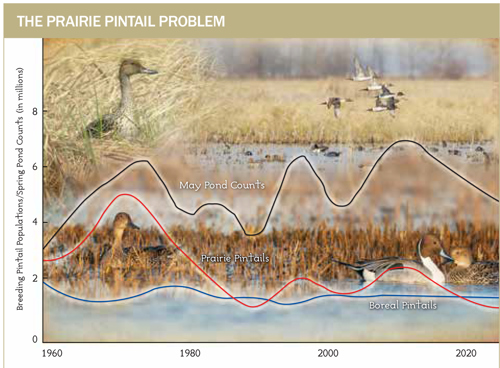
Data in the chart above comes from the Waterfowl Breeding Population and Habitat (BPOP) Survey. Prairie pintails include birds counted in North Dakota, South Dakota, and Montana, plus southern Alberta, Saskatchewan, and Manitoba. May pond counts are from the same region. Boreal pintails include birds counted in Alaska, the Yukon, the Northwest Territories, and the northern portions of AB, SK, and MB. You can see that prairie pintails have declined with May pond counts, while the Boreal population has remained steady.
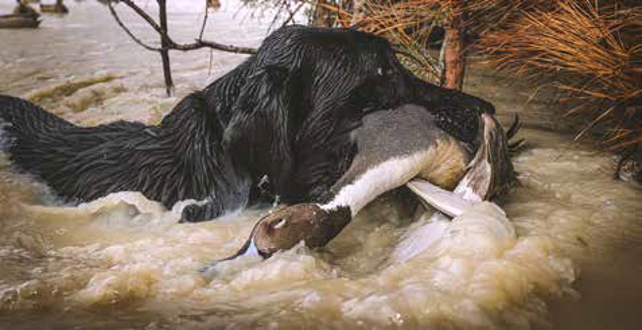
A CLOSER LOOK AT PINTAIL LIMITS
When pintail limits were expanded to a three-bird daily bag for the 2025-2026 season, the No. 1 question on every duck hunter’s mind was “why?” Afterall, pintail populations have declined significantly since the 1970s, from 6 million birds to 2.2 million in 2025. Plus, the 2024 Waterfowl Breeding Population and Habitat Survey revealed that the breeding population of pintails had declined by 11% from the previous year and was 49% below the long-term average.
Due to more liberal limits in Canada (and the difficulty in distinguishing hens from drakes during the early season), many hunters were concerned the increase in harvest in the U.S. would severely impact the overall population. However, pintail numbers have been steady for more than a decade.
Most of the birds (40%-50%) are taken in the Pacific Flyway, specifically California. In the 2024-2025 season, more than 86,000 pintails were bagged in California, accounting for 17.3% of the national harvest. The next closest was all of Canada (51,000), followed by Texas with just over 41,000. From 2020 to 2024, 91% of the pintails shot in California were drakes. Texas was slightly less at 78%.
The change in limits resulted from the inclusion of an additional 10 years of breeding population monitoring and from a better understanding of the effects of pintail harvest. For example, a majority of California’s pintails come from the boreal and sub-arctic breeding grounds, a population that has been stable since the 1960s. Central and Mississippi flyway pintails mainly breed on the Canadian prairie. That population has also been stable since 2013.
Knowing this (along with decades of scientific data), waterfowl managers recommended a three-bird limit. The 2025-2026 data was not available at press time, but it will be interesting to see what, if any, effect the change had on pintail harvest. Stay tuned… — Joe Genzel
--
Dr. Todd Arnold is Delta Waterfowl’s senior scientist. Previously, he served as a distinguished teaching professor at the University of Minnesota’s Department of Fisheries, Wildlife and Conservation Biology, a senior scientist for Ducks Unlimited Canada, scientific director for Delta, and an assistant professor of wildlife management at Humboldt State University. Arnold has authored or coauthored over 130 peer-reviewed papers and presented more than 150 papers at scientific conferences.
His work with northern pintails has been a collaboration with Drs. Bob Clark (Canadian Wildlife Service), Mitch Weegman and Qing Zhao (University of Saskatchewan), Jim Devries, Dave Howerter, and Matt Dyson (Ducks Unlimited Canada), Thomas Riecke (University of Montana), and the late Dan Gibson (University of Minnesota). Arnold is grateful for their knowledge, insights, and dedication to our shared waterfowl resource.