
High-Tech Tools Make More Ducks
Delta’s innovative trapping approach improves nest success on the prairies
BY CHRISTY SWEIGART
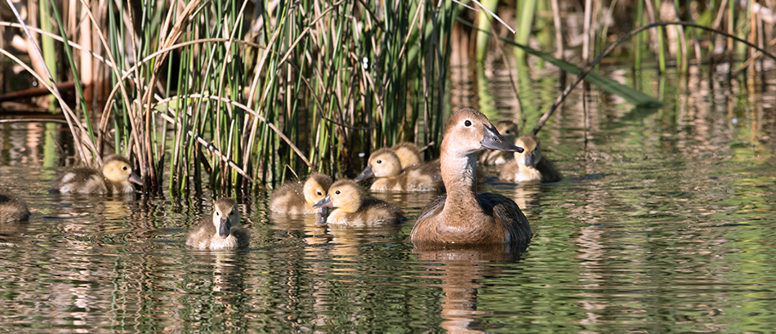
By the time most duck hunters start thinking about fall flights, the state of the Prairie Pothole Region has already made many decisions for them. This vast and unique landscape — known as North America’s Duck Factory — features an abundance of wetlands, seasonal potholes that appear each spring, and nutrient-rich soils, all working to create a mecca for waterfowl production. Although the PPR comprises only 1.1% of North America’s landmass, in wet years it can account for up to 70% of the birds duck hunters harvest.
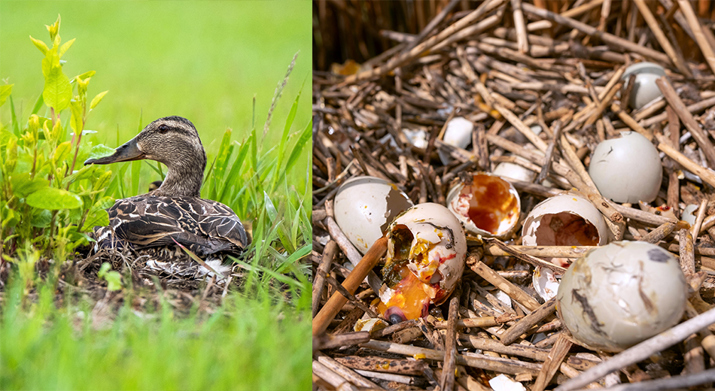
A duck nest the size of a cereal bowl on such a wide expanse may not seem like much. But if it’s destroyed before hatch, the fall flights take a hit. Multiply that by hundreds of thousands of lost nests across a landscape inhabited by a burdensome number of predators, and the impact becomes significant.
In any system, you must start by fixing the leak causing the most damage. For nesting ducks, that’s predation. When a nest fails, it is often because a critter finds it. Studies show that up to 90% of failed duck nests are destroyed by predators.
“A raccoon or skunk eating a duck nest is a common outcome in places like the PPR, where the predator-prey relationship has become out of balance over the past decades,” said Mike Buxton, Delta’s waterfowl programs director. “That matters because nest success is the most important driver of continental duck populations. When we achieve higher rates of nest success, the fall flight is better for hunters.”
During the 1930s, nest success of 35% was common. Recent studies reveal that duck nest success is down 5% to 10% in many areas of the prairies. Nest success rates must be between 15% and 20% to prevent duck populations from declining, and even higher to allow populations to grow.
Delta recognized long ago that if we want more juvenile ducks entering the fall flight and better hunting seasons, we must manage the landscape to give more nests the opportunity to hatch each spring.
A Targeted Approach
Delta’s Predator Management Program is not vague, broad, indiscriminate trapping across the PPR. Delta’s approach is targeted during nesting season, with predator removal deployed in areas where returns are highest.
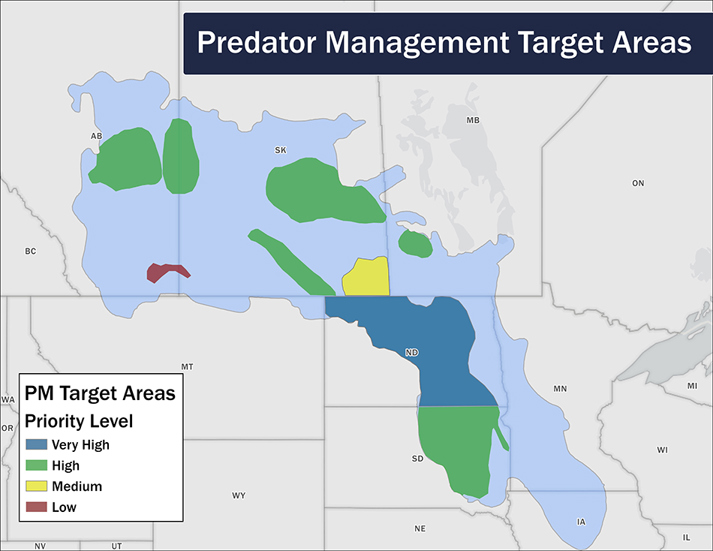
Over the past century, agricultural development and wetland losses have dramatically altered the landscape of the PPR, disrupting the natural balance between waterfowl and predators. Delta focuses Predator Management on areas where that predator/prey relationship is out of balance. The goal is to boost nest success by reducing key predators, such as raccoons and skunks, where there are high concentrations of breeding ducks and nest success is predicted to be low, or below the population threshold.
In other words, Delta’s Predator Management is built to produce ducks in places that should be producing them but aren’t.
“Delta has been researching Predator Management since 1994,” Buxton said. “We have looked at this from about every angle you can look at it. We have a lot of confidence in how we deploy seasonal Predator Management across the landscape, so we know we are getting consistent results time and time again. We’ve built the tools and processes to support scaling it to make the biggest impact on waterfowl populations.”
Trapping Toolbox
During the past 31 years, Delta has refined tools to ensure Predator Management remains effective as it scales. Technology, data, and analysis form the foundation.
Delta’s Predator Management is deployed in targeted areas with high breeding duck densities and little grass cover. Delta’s researchers have whittled down the information to learn the most effective recipe for improving nest success. To ensure maximum efficiency, technology is used to select trapping sites.
“A lot of what we use for site selection is a land-cover layer on GIS (Geographic Information System),” Buxton said.
The land cover layer is derived from remote-sensing data. Most hunters have used map layers through apps like onX. Delta uses similar technology to identify high-value trapping sites.
“Utilizing a land-cover layer helps us get an idea of what the habitat composition is like in a given area on a landscape,” Buxton said.
“For example, we can see what percentage of the landscape is grass, crop cover, and water. It’s our first cut at looking at sites.”
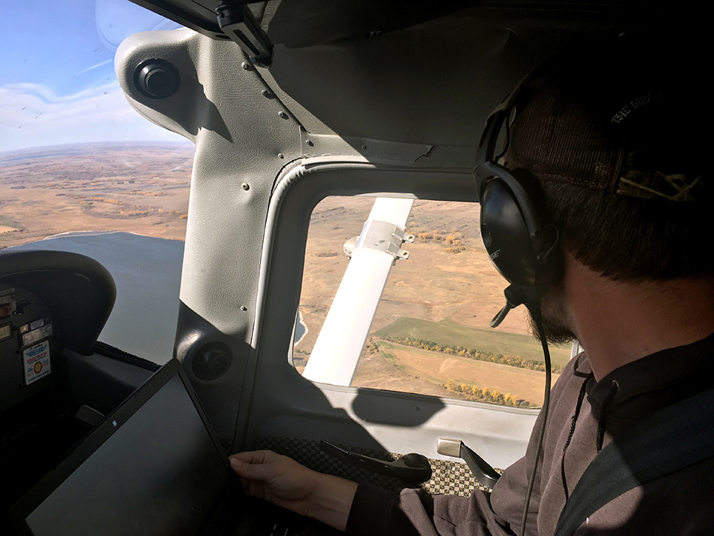
After identifying potential sites using that data, the team analyzes images of the landscape before they get up into an airplane and look at the current conditions.
“In October, months before the first duck returns to the prairies up north, we take a better look at our prospective trapping areas,” Buxton said. “Flying that late in the year allows us to see what the landscape looks like right before the snow flies, which gives us a good indication of spring conditions.”
While in flight, Buxton is observing the area with prerequisites in mind.
“While airborne, we survey wetland conditions, water levels, road access, the amount of nesting cover, and any possible impediments to trapping to decide if the area is ideal for Predator Management,” he said. “Flying is crucial to the site-selection process because it allows us to see everything at once, instead of piecing information together from ground surveys.”
Once a site passes the aerial test — high breeding duck numbers, low grass cover, and accessible terrain — it’s considered for the spring trapping season, which takes place the following March.
Data on the Go
Targeted site selection solves the question of where to trap. But with contractors dispersed across states and provinces, managing thousands of acres from March through July, technology to track and direct these programs becomes critical.
Prior methods of recording relied entirely on paper records, in which trappers manually documented trap placements and animal captures. Paper records provided basic data, but required significant processing and lacked precision. In 2014, Delta implemented GPS tracking using handheld Garmin eTrex devices, requiring trappers to record GPS coordinates when setting traps and catching animals. While the method improved spatial understanding, it still relied on manual recording. These GPS units were used for a few years before one-way satellite messaging devices — known as SPOT — were implemented as an upgrade, though they still lacked higher levels of customization the organization was seeking.
In 2020, Delta implemented the first version of the current phone app-based software — a proprietary app specifically designed for the scale and intricacies of Delta’s program deployment. This ultimately eliminated paper records and now provides instant, detailed data transmission between numerous contractors in the field and program directors who look at the big picture to manage checks and balances.
“The data is sent directly to us in real-time and uploads into one big dashboard,” Buxton said. “What that allows us to do from a manager standpoint and a researcher standpoint is we’re able to look at where all the traps are at any given point and where all of the animal catches have been. We can look at catch patterns and trap dispersion patterns to ensure our contracted trappers are deploying tools in a way we know will improve nest success.”
The app also includes a map showing all trap locations. So, the trappers themselves can see where they have traps, where they caught animals, what exactly was caught, and other data important to their work, Buxton explained.
Delta’s Hen House program contractors use a separate version of the app to track the locations of nesting structures and their maintenance needs. The app allows contractors to upload images and troubleshoot issues in real time with Delta program directors.
“We have trappers and Hen House specialists deploying our programs all across the PPR,” Buxton said. “These apps are a practical way to maintain program consistency across an increasingly large network of contractors.”
Predators and Patterns
These 30-plus years of Predator Management research have amassed an immense catalog of data, rich with patterns, information, and insights into the program and the landscapes on which it’s deployed.
In July, Delta hired Dr. Todd Arnold as senior scientist. He has been analyzing data to identify patterns that improve the program’s effectiveness, uncover new trapping opportunities, and help Delta adapt to changing landscapes.
Already the most effective approach to improving nest success on the prairies, this analysis will continue to push the program forward, exploring ways to refine it further.
“One thing I am constantly thinking about is that landscapes are changing,” Arnold said. “What worked in the past isn’t always going to work the same going into the future. So, we always want to be doing some assessment to figure out how things have changed. A good example of how things have already changed is the early work going back to the mid-1990s. At that time, the red fox was very common in the landscape. It was the most important predator. Now, they’ve been replaced by coyotes.
So, it’s a different predator community, and we’ve had to adapt to that. Going forward, I see us always doing some sort of assessment of our Predator Management to ensure it maintains a high level of efficiency.”
Scaling Up
Delta’s Predator Management program is now scaling across the prairies in ways that once seemed out of reach. During the 2026 breeding season, the program will operate at 51 sites strategically placed across Alberta, Saskatchewan, Manitoba, North Dakota, and South Dakota. As the program has grown, so has the sophistication of the tools that support it.
The program is built to fit the real PPR not an idealized version. In fact, an estimated 90% of duck production in the PPR occurs on private land, in working country where farming and ranching operations are ongoing.
“The tools that move duck production have to work alongside farming and ranching without interference,” said Joel Brice, Delta’s chief conservation officer. “Our tools are complementary to both working land and all of the other valuable habitat work that’s going on.”
The goal of Delta’s Duck Production programs, Hen Houses, and Predator Management is to boost the largest driver of continental duck production: nest success. Following Delta’s successful Million Duck Campaign, these programs will continue to scale up to increase the impact for ducks and duck hunters.
“Delta’s Predator Management began as an idea that many people doubted,” Brice said. “It became a program because the PPR needed a tool that reliably moved nest success rates in a positive direction. Today, it’s getting more modern for the same reason it was built in the first place: to stay targeted, consistent, and accountable at the scale that our Duck Production goal requires.”
The targeted approach to Duck Production feeds directly into what Delta calls duck distribution — the concept that explains what hunters experience each fall. Why were birds spread out one year and concentrated the next? Why did one flyway look healthy while another seemed thin? Weather, agriculture, and habitat all play roles in how ducks distribute across the continent. More ducks hatched on the prairies means more ducks moving through every flyway, regardless of how the other variables shift year to year.
Delta’s Predator Management program is projected to produce 750,000 ducks and another 250,000 from Hen Houses. That’s 1 million ducks every year, forever. Three decades ago, that seemed impossible. But today, Delta has the research, tools, and technology to help the Duck Factory deliver on its production potential.
Christy Sweigart is associate editor of Delta Waterfowl.
Delta's Initiative to Train More Trappers
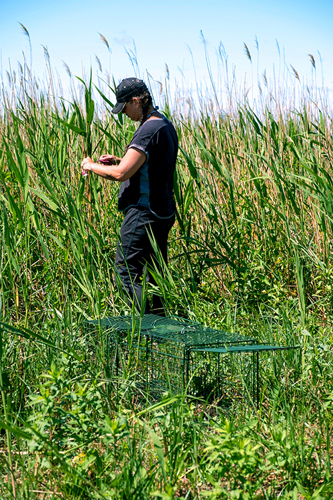 The number of experienced trappers in North America has declined significantly over the past few decades. During the first half of the 20th century, commercial fur harvest helped suppress medium-sized predators such as raccoons, foxes, and skunks. But when fur markets collapsed in the 1980s, so did the number of trappers. In Saskatchewan, trapping license sales dropped from a mid-20th century peak of more than 25,000 to fewer than 2,000 by the millennium.
“Like hunters, trappers are an aging demographic and thus becoming more difficult to find and employ,” said Mike Buxton, Delta’s waterfowl programs director. “The primary goal of the Trapper Training Program is to ensure Delta has enough skilled, professional trappers ready to hit the field as our Predator Management program continues to scale up.”
Delta plans to host the first class of the Trapper Training Program in spring 2026.
Enrollees must first complete their state/provincial trapping education course or the Association of Fish and Wildlife Agencies’ course. Once complete, students attend a two-day field experience that includes Delta’s Predator Management-specific trapping techniques and strategies.
To prepare students for the field, Delta is developing a trapping manual specific to its Predator Management work. The manual will serve as both preparation material and an ongoing reference for all Delta trappers.
“There are many similarities between Delta-style trapping and the usual fur trapping, but there are a lot of differences, too,” Buxton said. “Our program and field-day components are built to prepare these trappers for the specific type of work and landscape where we deliver these trapping programs, so they are learning on real-world examples.”
The active trapping portion of the course will be held on a Predator Management site near Delta’s U.S. headquarters in Bismarck, North Dakota. After completing the field day, students shadow an experienced Delta trapper for a few days to a few weeks, depending on their level of experience.
“It’s more than just a one-day field component,” Buxton said. “They need to see how things change on the landscape and how they need to do things differently during different times of the year, because conditions change drastically from mid-March to mid-July. A lot of the nuanced components come up when they’re shadowing a Delta trapper, which allows them to learn and be better prepared when they hit the field.”
Once the course, field day, and shadowing have been completed to the required level of satisfaction, trappers become eligible for a Delta trapping contract the following year. —Christy Sweigart